The ability to buy a huge range of books online has always been incredibly useful, and never more than at the moment. But it doesn’t bring quite the same joy as an unexpected gift while you’re in a bookshop with family or friends. Or discovering something odd in a charity or secondhand shop and taking a risk for 50p.
Lockdown has actually provided various examples of serendipity and surprise kindness. Including the chance to finally finish books I’ve acquired or received in both ways – and that encompass very different areas of interest.
I don’t judge anyone for buying from Amazon. It would be incredibly hypocritical, especially as I do use their affiliate links to recoup some of the costs of hosting and maintaing various personal projects. But I’d encourage everyone to try and balance it with supporting local bookshops and small retailers wherever they can. You can find a lot via the Booksellers Assocation.
As I get older, I can still remember time spent wander around Baggins Book Bazaar in Rochester, which is a tardis-like warren of old paper smells and random discoveries. Or a recent family visit en masse to Uptown Vinyl Records in Spalding, where three generations of us spread across the wide selection of secondhand records and CDs.
It was great to see my young son huddled under a table rifling through hiphop as I would have been doing at around the same age, and look across to see my dad precisely running through classic vinyl in the same experienced manner I’ve witnessed on countless record shop visits.
I’m digressing from sharing my reading habits, but it’s important to remember good times with family and friends during a period when we’re physically separated.
Back to the books.
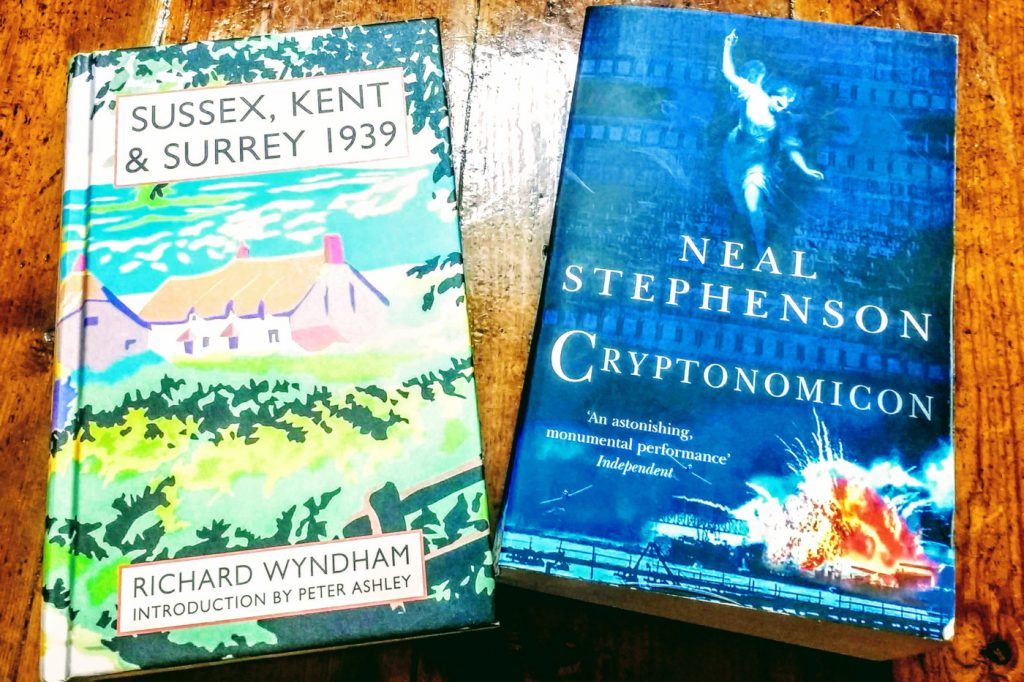
Sussex, Kent & Surrey 1939 by Richard Wyndham
I don’t usually read many travelogues unless it’s about somewhere I intend to visit one day. Or it involves motorcycles and cars.
But having spotted the title and the rather delightful hardback cover on a charity shop shelf, I was intrigued enough to flick through and discover Wyndham had journeyed through a number of places familiar from my childhood. So I paid my 50p donation and it sat in my ‘to read’ pile until lockdown allowed me to get to it.
And it’s been a wonderful discovery. As the author says, “It would be unwise to lay down an itinerary for these by-ways of the North Downs, for it is by haphazard exploration that they can be best enjoyed”.
Which is an approach the aristocractic former soldier, painter, and eventually foreign correspondent for the Sunday Times until his death in 1948, follows by randomly driving and walking around the counties with his sheepdog. The fact that he indulges his particular interests and favourites makes it all the more enjoyable.
There are some well known local curiousities of the time. Such as the infamous Jezreel’s tower built in Medway in the 1800s by a bizarre religious sect, and sadly town down years before I grew up in the area. And visits to places familiar from my childhood, whether that’s Rochester or Canterbury.
But the book mainly devotes itself to smaller, more obscure places. Odd carvings in small chapels which could only be reached by foot in those days. Or in villages which even then you’d bypass by car unless you specifically knew there was a worthwhile reason to visit.
“Between Sittingbourne and Gillingham a narrow road follows the bank of the Medway estuary through Lower Halstow, where there are large brickworks and brick-laden barges moored in a smelly creak. We come to the village over a small hill. It would be rash to state that this is the most beautiful view on the coast – landscape-painting has taught me that such beauty depends too much on the light, the season, and one’s momentary frame of mind.”
I know exactly where he is, and what he means. But through his eyes I can see it at the time my late grandparents (and great-grandparents) were living and working there. And compare it with how I experienced it as a child, and the photographs my uncle now takes as part of his birding. Or my own recent experiences after moving back to the area temporarily, with a more mature appreciation of the local history and beauty than I had when I originally moved away.
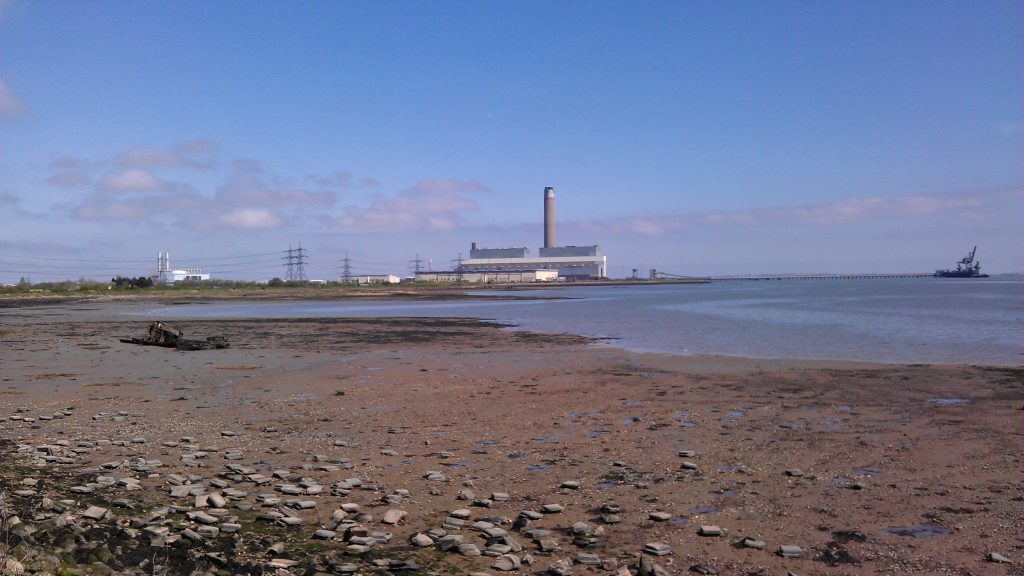
Before anyone points it out, I know this is on the opposite bank of the Medway, but my limited photography skills limit my choices of estuary scenes. And without the brickworks still in operation, it sums up mixture of nature and industry in the area nicely.
Especially as Kingnorth was closed in 2012 and in the stages of demolition between 2014-2017.
Would I have bought a book written roughly the same distance before my birth as I’m now aged from it if I’d somehow stumbled across the Amazon listing? I very much doubt it.
But will I part with my copy now, given that I could get an 800% markup on what I paid for it? Not likely!
Cryptonomicon by Neal Stephenson
Like many scifi fans and people in tech, I’m a huge fan of Snow Crash, the 1992 novel that everyone seems to have recommended at some point. And during a bookshop visit while back in Kent, I picked up the heftier Cryptonomicon to browse. At which my point my mum interrupted my deliberations to buy it as an impromptu gift.
That was back in 2015/2016. And I’ve started reading it a couple of times since then, only to get distracted by other books, or misplace it during a house move back to East Anglia. But lockdown presented the ideal time to finally focus on actually diving into the historical techno-fiction which blends historical figures and in-depth explanations of modern cryptography with a fictional story pulled together by characters in various times from 1942 onwards.
It’s a hefty work at 918 pages. And it’s a book that I’m glad I’ve finally made the concerted effort to read. It’s interesting, admirable, and a springboard for anyone interested in cryptography and technology.
So it’s unsurprising that I would be in the Venn diagram of likely readers. Even if some of the more detailed modular arithmetic does hurt my brain, especially as pretty much all my maths knowledge from earlier years has lain dormant and slowly been ousted in favour of words.
Quantifying my enjoyment of Cryptonomicon is trickier. It’s well written, readable (aside from the more complex maths and crypto explanations), and has moments of action, comedy and tragedy throughout. But the expansive cast list made it a bit of a struggle to empathise at times, particularly with some of the less prominent characters. The Wikipedia summary lists 9 main characters for the WW2 era, 10 for the “modern” 1990s plot, and 6 which cross over both timelines.
But I’m certainly glad I made the commitment to reading it (apparently it was required reading at some tech start ups, e.g. PayPal), and I’ll treasure it both for the fact it’s fascinating, and it was a surprise gift from someone who (along with my maternal grandmother) played a indescribably big part in my love of reading. (Amazon link)

